
Ground News has been sold to me as nothing less than the solution to all problems readers face with journalism. The idea is that all media is biased, and so the only way to get to the Truth™ and start to Think Freely™ is by comparing left-wing and right-wing news sources. They also try to surface “blind spots” to you, ie news which are underreported by one “side”.
And while there’s some use to this, overall it falls pretty flat. Let’s start with the papercuts and work our way towards the dealbreakers.
- Problem 1: The news is incredibly US-centric
- Problem 2: “Blindspots” are very unhelpful
- Problem 3: The Bias
- Problem 4: Bias isn’t even a problem
- Aside: Who even is Ground News?
- Problem 5: Other News Aggregators exist
- Conclusion
- Update, 12 Aug 2023
Problem 1: The news is incredibly US-centric
I’m using the “Europe edition” of the thing, but there’s comparatively little europe-relevant news, especially in the “blindspot” section which almost exclusively is US politics. The news that it is surfacing isn’t super relevant either – the “latest stories” often are accidents, non-English language news are missing altogether.
But even switching the location to London or the UK in general, which should have plenty of high quality English reporting available on a variety of issues, the local content suddenly becomes hyper-local and is “pub burned down”, “accident happened”. It seems that “UK politics news”, “UK economy news” and such aren’t grouped under “UK news”, but rather that “UK news” are all the miscellaneous stories which don’t fall into the main news verticals. To be clear, “UK politics news” is an interest you can follow, but having a “Europe edition” which apparently doesn’t do just that by default is pretty weak.
It also is worth noting that the Daily Mail is missing from Ground News. That probably is a point in favor of Ground News, but also, huh.
Problem 2: “Blindspots” are very unhelpful
One of the hero features of Ground News are the blindspots – stories that are underreported by one side. And while this may be a noble cause in theory, in practice I found this rarely useful.
For one because of the US politics focus. To me, Hunter Biden is at best tangentially relevant to US politics, but apparently to the right, he’s a key factor to proving that the Biden administration is incompetent/evil/what have you. Seeing these news turn up in my inbox isn’t helpful to me seeing both sides, it’s highlighting the sort of partisan screaming matches which report on very little of substance.
In the cases where the “blindspots” aren’t about US politics, they’re even less helpful:

What happened here isn’t that the right hate baby animals, or that the left is obsessed with baby animals to distract you from what really matters – this is one of the fluff stories by McClathy Media Network which gets syndicated to 20 local newspapers. All of these newspapers are probably pretty much the same, just localized to a different town. For stories that go beyond the scope of the local edition, there probably is a shared editorial department. Which makes the bias distribution on their newspapers a bit questionable as it largely is word-for-word the same content.

Which brings me to the bias itself.
Problem 3: The Bias
Ground News puts an emphasis on three factors they track: Bias, factuality and ownership. Let’s talk about bias first.
The bias is biased
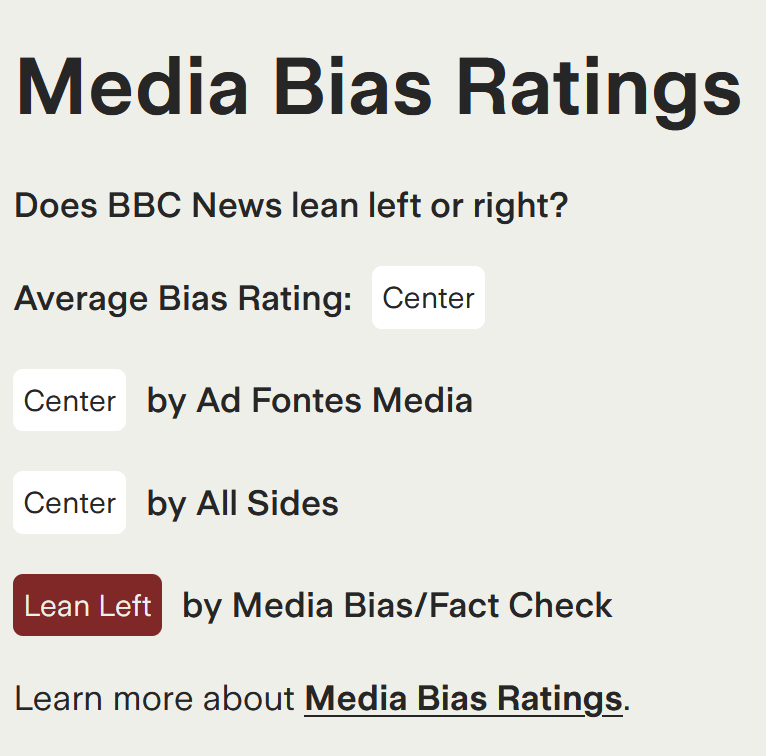
Ground news takes the average of 3 bias finding sites. The sources, in turn, have different methodologies to find out bias: Ad Fontes Media uses editorial reviews, All Sides uses a panel of editorial reviewers as well as blind tests, and Media Bias/Fact Check seems to be mostly just one guy doing editorial reviews. In the case of blind tests, you can read a text and then judge how far left or right you think this is, with editorial reviewers you can check certain words or phrasings which give away bias.
All of them have in common that they’re focused on the USA way of doing things. All of them have in common that they are underfunded to carry out the mission they claim to do.
The articles they check are minuscule to the corpus they’re judging – looking at 20 articles, a hundred, even a thousand articles of any reasonably large outlet doesn’t even get you one review per journalist. So the categorization is at best a first impression, but it very unlikely to be massively scientific. Let’s take a look at the BBC for example:

Each of the blobs is an article AdFontes has reviewed. Not the green dashes, that’s the “very reliable/mixed reliability” separator, just the dots. The most reliable story the BBC has ever reported on is Pro-Trump protesters storm the US legislature – in pictures, apparently, so a slideshow. Well visible in this chart is a bias by the reviewers to rate the stories neutral, whether that is because key words are missing or because the reviewers know it’s the BBC and want to rate it neutral is unknown. An unbiased chart would show a more shapeless point cloud.
The bias data are based on not much
For the “BBC World News” (which merged with the main BBC News channel earlier this year) it’s worse still:

Looking at three (3) articles apparently is enough to them to confidently present a reliability score of 44.56 and bias score of -3.78 on their website. Two significant digits for three data points. You could do a more thorough job at figuring out the BBC World News bias with your buddies on an afternoon.
In the case of news sites which are still going, the situation is sometimes slightly better, with some of the McClathy local newspapers even having more than 20 data points. Others aren’t measured at all.
This of course is just Ad Fontes Media, which gives us how many data points they have. The other two are less helpful, All Sides gives a mild confidence indicator (“low or initial confidence”), MB/FC has nothing of the sort.
Ground News does the best job they can by averaging ratings from these three, but lose the confidence indications which exist along the way. They still are at mercy of very shaky ground with these assessments – yet they’re presented as the compass to navigate the news landscape, the major tool to Think Freely™.
Center bias is also bias
Being in the center comes with a set of beliefs, such as: Both sides are arguing too much, both sides should come to an agreement, both sides should be quoted on an issue. This can lead to nonsense being spread for no good journalistic reason.
For example, in the Russian-Ukrainian war, there are three major sources for losses: The Ukrainian and Russian governments, and independent OSINT analysts such as Oryx. Naturally the two parties of the war are biased in how they count losses, but if the Russian government claims to have destroyed more equipment than Ukraine had to begin with or destroyed equipment before it even has arrived, these are lies and should be either contextualized as disinformation if reported, or not reported at all. There is no need to only say “both claims could not be verified” if one of the claims is very evidently a lie. Trying to appear unbiased by reporting both sides as equivalent informs the readers less well than a biased-appearing reporting that acknowledges the Russian information war.
Additionally, being in the center is a consequence of privilege. In situations of for example exploiting elites vs starving poors, minorities vs genocidal majorities or authoritarians vs civil liberties, you only really can be centrist if the issue at hand doesn’t affect you directly.
As such, centrist reporting tends to have a bias towards the status quo built-in. And this bias, too, is causing the journalists to disregard certain stories or bits of information, just not necessarily in a way that’s immediately visible on a left-right spectrum.
Problem 4: Bias isn’t even a problem
News outlets have an obligation to their audience regarding what they report on. If The Economist started publishing stories about how to best care for your garden, it’d weird you out, but if something called My Weekend or Gardening Digest (no idea if either exist, but wouldn’t surprise me) does, it’d be fitting, and it’s likely that the advice on gardening published in Gardening Digest is going to be more useful than anything from The Economist, which might pivot the article into “how to run your garden as a startup” eventually.
In the above example, it’s not bias which is making The Economist‘s article weird, it’s expertise. They have a lot of it in the topics of politics and economy and trading, but not much in gardening.
National and international general audience news organizations sit in the peculiar position where they have to report on quite literally anything that could be important while also having to report on it such that the layperson understands it, while also being non-experts in the subject themselves. And just from this description alone you can tell this is a hard job to do justice, explaining the world without inherent expertise.
Showing general audience news which may be biased side-by-side to cancel out the bias isn’t really helpful. You’re never gonna get the necessary depth to truly be informed from smashing Fox News together with CNN, because both of them lack expertise in their day-to-day reporting.
And to be clear, journalists don’t need to have the deepest of expertise in the stuff they report on. Their job is to just find information that’s relevant to the public discourse, their job is to ask people with the right insights. They have enormous pressure to report on whatever is BREAKING today, they have pressure from publishers which want to cut cost by employing chatGPT, and a generally decreasing trend in revenues.
Let’s take Trump’s indictments as an example: When they were announced, news organizations all over immediately went to report on that they happened. None of the initial reporting has much insight beyond that. A second wave comes in later with analyses and opinions by potential experts – but here already the usefulness decreases. Your average media company may have a reporter in Washington, but they generally don’t have a criminal lawyer who has experience in defending or prosecuting alleged classified information leakers and conspirators ready to go, so often times people from related fields are drawn in instead. And even if an actual expert is on hand, if they were to go through the matter count by count, they’d probably need two thirds of a newspaper all by themselves, so the sharpest points have to be isolated, potentially taken out of a wider, more meaningful discussion. “Is Trump Guilty, yes or no?” is what’s interesting to the public, “what are the charges, what are the precedents and when can protected free speech be part of a criminal conspiracy” is what would actually be informative, but it’d take an hour to get through it.
Special interest news
But there are news sites which aren’t bound by the interest of the general public and have the time to do hourlong pieces on a single topic. Special interest magazines and industry news have existed for a while, and thanks to the power of the internet it typically is quite easy to get ahold of much of them because they’re just another website.
For me personally, these are sites like lto.de (German), which puts legal contexts on current events, Heise.de, Golem.de and whatever pops up on Hacker News (en) for tech related news, netzpolitik.org (de) for civil liberties issues in Germany and the EU, Perun (en) for videos on background information regarding the Russian-Ukrainian war and other defense economics topics, dekoder.org (de) and ridl.io (en) for insights into Russia, and even occasionally agrarheute.com (de) for info on how farmers deal with new challenges arising through weather, climate and other new realities.
This info is at times so specific, it has no reason to exist in news sites aimed at the general public. It also is extremely insightful if it ends up answering the question you had.
- It makes economic sense for Russian citizens to go to war as 5 months of service and then dying gets their families as much income as them working for 31 years at average salary. Vladislav Inozemtsev – Putin’s «Deathonomics»
- The Russian army is so much weaker than we expected because between lies, corruption, procurement and politics, the actual quality of the army was actually driven down hard. Corruption and lying are survival skills in authoritarian governments. Perun – How Lies, Corruption, Procurement and Politics destroy Armies
- The German minister of transportation made a road toll thing which ran afoul of EU law and ended up costing half a billion euros. He probably isn’t liable or guilty for it, but it is an interesting exploration of civil and criminal law. Dr. Patrick Heinemann – Schuldet Andreas Scheuer dem Bund 243 Millionen Euro? (German)
The above points, that is, shortening a complex topic into a one-sentence summary which can be understood by anyone (hopefully) is already some light journalism on my side btw. I’m left-leaning by the way, so the above topics are carefully chosen to push the left agenda by what interests me at the moment. An example on how things work for me might be the following:
I’ve got some rapeseed fields near me, which don’t dry out because it’s raining every other hour for the past couple weeks. My question “how long until things turn bad?” got answered by this article (German) with more questions – apparently it depends on a variety of factors and harvesting rapeseed is highly variable to begin with. Well, why is that? I used this as a jumping off point to find out more about rapeseed variants (which have names such as LUCIFER and CROCODILE, no joke) and worked myself into a bit of a rabbit hole to inform myself. In other words, what happened here is that these special interest news sites enabled my curiosity, to find out more about the world around me.
Ground News doesn’t do that. “A Premium subscription helps you rise above misleading narratives and sensational reporting while saving you time and energy”, they say – or in other words, they want to help you avoid “biased” stories and low factuality stories. But then what? Is “being informed” really just reading surface level reporting of as many different topics as possible while avoiding known disinformation sources like RT?
Aside: Who even is Ground News?
It is incredibly difficult to find any information about Ground News or the company running it, Snapwise, Inc. Their mission page only says “We are a small team of independent media outsiders based in Waterloo, Canada, who is concerned about the future of news”. The people running it which are named are just the founders, which on their about page are described as such:
Ground News was co-founded in 2018 by former NASA engineer, Harleen Kaur, and award-winning app developer Sukh Singh
Kaur also was a VP at Rolls-Royce and co-founded uCiC, “an app that lets users see anywhere in the world in real-time by letting users ask for on-demand, real-time photos and videos from any location”, Singh previously had some brief stints at Siemens and P&G before first ending up as a consultant for a while and being the other co-founder of uCiC. You can see what this app did in the Internet Archive – IMO it’s a mildly more interesting street view with some mildly lame use cases (“know what the vibe in the club is before you go!”, “is there a lineup at the coffee shop?”), but which is an excellent tool for stalkers, spies and data harvesters in general.
I’m highlighting this for two reasons:
- While the two are apparently very competent at solving technical problems, they are venturing into an area here which they don’t know anything about. This can be enriching – outsider art is very interesting, for example – but it also means that they’re at risk of building up a solution to the wrong problem because they don’t understand the problem space well enough.
- The two have a track record of building tech without evaluating their impact on society. They’re not alone in this, for example Apple’s Airtags solve a mildly annoying problem (“I keep losing my keys”) and turn it into a global surveillance issue.
With that said, I think that ground news doesn’t have nearly as much destructive potential. It may cement the idea of left-right biases being the only bias that exists, it may undermine itself in its own product page:
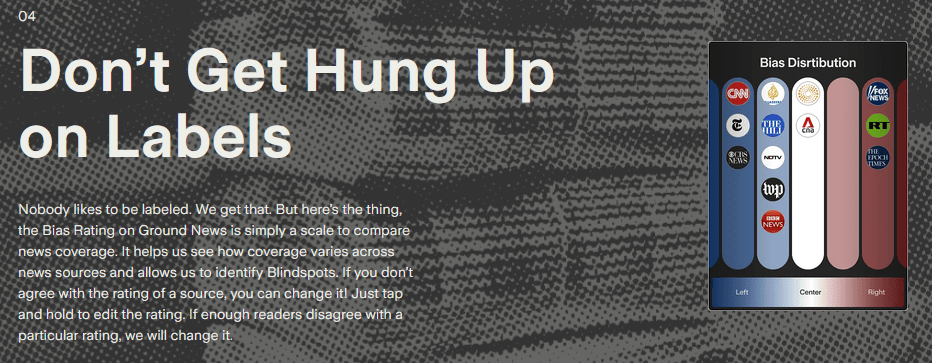
But Ground News doesn’t exist in isolation.
Problem 5: Other News Aggregators exist
Let’s take everyone’s favourite ethically questionable ad platform Google and see what they have on offer: The Google app and Google News.
The Google app has a feed of things which are interesting to you – so the exact thing Ground News claims superiority over by showing you news which you usually wouldn’t get. Google News on the other hand…
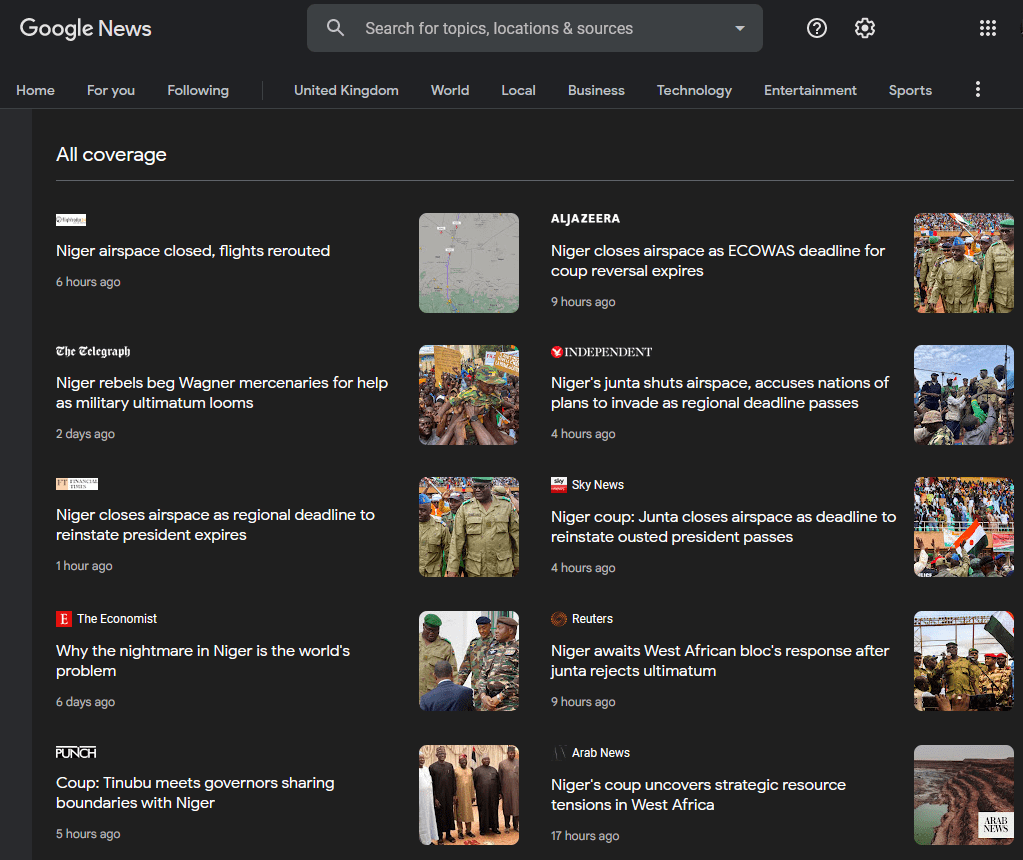
Oh no what’s that? Different sources on the same topic? A “Following” feed which you can customize, but also some sensible default categories for UK, World, Local, Business, Technology and so on? Localized feeds for non-English languages? And all of this for free?
Ground News only USP over Google News is that the bias is shown everywhere, that you can find blindspots in coverage and for more expensive plans, that you are shown whether the media outlets reporting on a thing are independent, owned by billionaires, or media conglomerates. The former two we discussed above as being done poorly, and the latter isn’t really too interesting IMHO: The vast majority of times, Bezos owning WaPo isn’t relevant to their reporting, and in the instances it is, it’s disclosed in the article.
Google News isn’t the only alternative to Ground News, either. Anything that does RSS is a news aggregator really, and any search engine apparently has a news source as one of it’s first offerings (that is to say, Yahoo News, Bing News exist as well). Which of those has the best offering I don’t know, maybe that’s a review for another time.
Conclusion
Ground News sorta sucks as a news aggregator and doesn’t offer anything meaningful to me. It wants to solve a societal problem with technology and falls flat on its face in the ill-defined mess it waded into. None of their features even deal with content directly, rather, from too few samples to draw solid conclusions they proudly present the bias and factuality of all articles a news site ever publishes.
The actual solution is one of curiosity. To read and article and think “I wonder why that is”, and starting research from there. Ground News doesn’t inspire curiosity beyond the most basic “what does the other side think about this?”
At 10 USD for the basic plan, it probably is worth a shot if you at all think this is useful – but don’t forget to cancel the autorenew when you do. At least you won’t be seeing the Daily Mail.
Update, 12 Aug 2023
Some friends of mine did some more testing with Ground News. Outside of the Daily Mail, it apparently happens somewhat often that Ground News reports something as a “blindspot” which actually is getting reported on by most major publications. In these cases it seems like their algorithm misses related news in grouping things together. This already would be problematic for the usability of a regular news aggregator, but for Ground News it kills one of their core features even harder.

 Leo Wattenberg