
Fantasy creatures are often shockingly unimaginative: Tolkien’s world consists of humans, pretty humans (elves), small humans (dwarves, hobbits), ugly humans (orcs), tree humans (ents), as well as a couple of bigger versions of regular animals (spiders, lizards, elephants). Outside of that, the overall flora and fauna is just regular earth, with regular horses, regular potatoes (boil ’em, mash ’em, stick ’em in a stew) and regular fishes. Or as another example, think of a franchise that has aliens with two legs and arms, and a head up top.
But it doesn’t have to be this way! We can do something more fantastical than that, while still going nowhere near Lovecraftian nightmares! We merely need to take a look at the weird and wonderful things which our world has come up with over time.
Step 1. Pick a symmetry
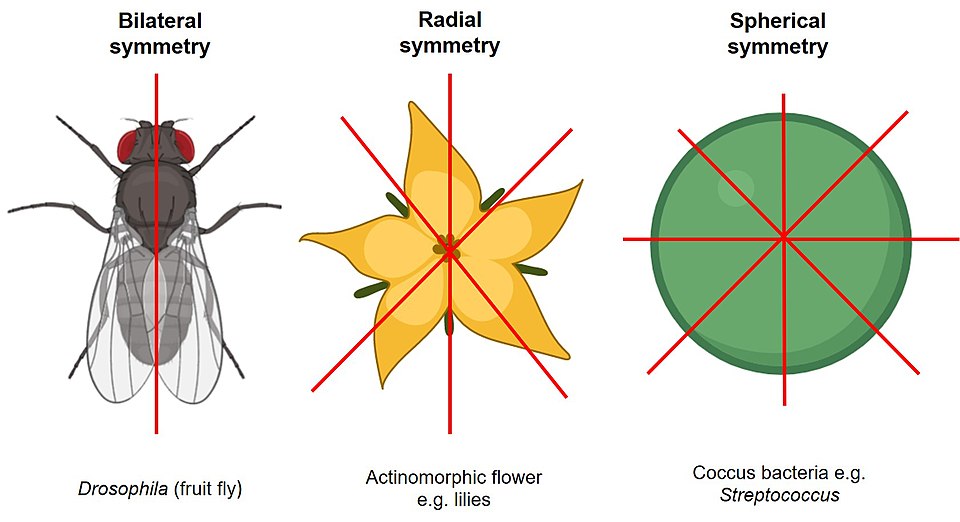
Charl Hutchings, CC-by-saEvolution tends to make things rather efficient (not to say: evolution is lazy), so as soon as structure gets involved, things turn symmetrical. This can be a simple left/right symmetry like we see on vertebrate (mammals, lizards, fish), or a radial symmetry like we see on various invertebrate (starfish, octopuses, anemones). Even single-celled organisms tend to go for a symmetry:

Step 2: Segment the body
Evolution still is efficient (lazy), so the next step is to make patterns repeat some more. The original arthropods that colonized land were essentially built like centipedes: One head segment where food goes in, many body segments with 2 legs each to get from A to B, and a butt segment where the food goes out. Similarly, our spines are segmented too, and can be copypasted a bunch to make the body longer (snakes) or shorter (tail-less apes, ie humans).
NB: A segment doesn’t have to be simply in line with another. Various plants are built with fractal patterns, where each branch gives rise to a number of smaller branches, which give rise to a similar number of even smaller branches, until eventually you end up with leaves. If you cut off any little branch of a cauliflower for example, the branch you’re holding in hand will (broadly) look the same as the big thing you cut it off from.

How segments connect to each other is determined by rules, but what each segment itself looks like is pretty much up for our imagination. Segments are generally symmetrical themselves, but if you have a good reason to only have legs come out the right side – go for it!
Step 3: Specialize the segments
We don’t really need 16 pairs of legs, how about we pick a couple main legs (maybe 3 pairs), and specialize ones near the front to be good at getting food into the mouth, some in the middle to catch the wind like wings and the ones in the rear… we don’t really need those legs, they can evolve away. What might such an animal look like? Boom, dragonfly.
Vertebrae similarly can be specialized to get ribs growing out of them, or spines, or other bony appendages.
Step 4: Optimize for purpose
After we have a good body plan going, we can optimize into various niches. For example, Canioforma (dog-like mammals) specialized into pack hunters by becoming more intelligent (dogs, wolves), big predators by becoming more massive (bears), water predators by streamlining their body and optimizing their legs into fins (seals), and burrow predators by shrinking down and elongating their bodies (weasels).
An example
With these steps in place, you should be able to get some more fantastical creatures going. NB, you don’t have to start at step 1 and create a whole evolution, you can take an existing animal and mangle it through steps 3 and 4 only. For example, let’s start with a mudskipper and learn a bit on how it lives:
OK excellent, we have a fish that lives on land with a powerful tail but less powerful fins, and frankly with a fin structure that is poorly suited to become strong legs. So instead of making a new “fish that went on land”, we’ll optimize the tail such that it becomes more suited to hopping on land, like a one-legged kangaroo. This leaves us with the front fins to play around with still. We could adapt them to be used to trap prey (so we’d end up with effectively a bouncing venus fly trap), or to signal (like a frilled lizard) or to synergize with their bouncing – to glide.
And just like that, I’ve evolved a mudskipper into a bouncing and gliding land fish, soaring across the lush meadows and lakes of Æerøıa chasing after small flying prey, perhaps migrating with the rain season to stay moist. And depending on when you read this, you may find a drawing of this animal I just commissioned here.
Prompts
- Horseshoe crabs and octopuses have their legs surround the mouth as the legs move food into the mouth. How does your beast get food from the environment into itself?
- Blood is red in us because it’s iron-based, but in horseshoe crabs it’s blue because it’s copper-based. What kind of blood does your beast have?
- Sea stars have tubed feet on which they walk. They have modified some tubed feet at the end of their arms to become primitive eyes. Chameleons can move eyes independently, hammerhead sharks have them far apart on their hammer. Where would it make sense for your creature to develop additional eyes, either to not get eaten, or to better detect prey?
- Reproduction can be all manner of freaky:
- “Lesbian geckos” are mostly female, mostly lay eggs that don’t need male fertilization, and only rarely have a male come in for some genetic diversity.
- Snails have both male and female genitalia, so they can impregnate each other (and sometimes themselves).
- Pigeons and platypuses lay eggs, but also produce milk. Some sharks and snakes give birth to babies rather than laying eggs, but don’t produce milk.
- Sexual dimorphism (visual differences between sexes) doesn’t need to exist, or may only be apparent during mating season. Humans are one of the few mammals whose females may have massive honkabadonkers all year round.
- Ants, bees and wasps only have a handful of sexually active members (queens, drones), all of the workers you see are technically female, but practically not participating in reproduction at all.
- Some fish transition between genders under certain conditions (once they become the biggest, or if too few of one gender are around).
- Insects tend to pupate between a walking/swimming larval form and a flying adult form.
- Plants and jellyfish alternate between sexual and asexual reproduction: One generation sends out spores/clones, and the generation that grew out of these clones produces sperm and egg cells, which themselves send out spores again. Some other plants integrate the next generation into themselves and only one kind of offspring is set out into the world.
- Yet other plants and mushrooms create massive root networks from which new plants appear to shoot out, even though it actually is all just a single being.
- Mating can happen on a spectrum from “massive competition to get laid” to “just release your sperm/eggs into the environment, they’ll figure it out”.
- How does your lil’ guy make more of itself? How do differently gendered individuals of your species interact with each other?
- But don’t think about animal fucking too much, or you’ll end up with the furries.
- Sexual pressure can cause any part of the body to become enlarged, even at the cost of daily convenience. Does yours?
- What scale is your animal operating on? Sufficiently small and simple animals tend to live without hearts, lungs, or intestines. (Insects, jellyfish are examples here)
Made any cool beasties? I’d love to see them! Feel free to reach out to me if you know me, or send an email to IMadeAReallyCoolBeast@leoxd.dk


