
Colossal Laboratories & Biosciences was in the news recently for “de-extincting” the Dire Wolf, a wolf species which went extinct after the ice age. Previously they had made a “wooly mouse”, a mouse with “wooly mammoth traits”. This, of course, is bullshit in several ways, but not yet what gets me riled up. It’s the greenwashing. But let’s back up a bit.
What even is a de-extinction?
Colossal cannot bring back a Dire Wolf, or a Mammoth, from preserved DNA Jurassic Park-style. What they do instead is edit the genome of an existing species to give it traits which merely resemble extinct species. Which is a significant difference: We have bred dogs to look like all sorts of things. Dog breeding is less precise than making 20 direct modifications in 16 genes with CRISPR/Cas9, but the end result is practically the same – the “de-extincted Dire Wolf” is just another dog breed. A dog breed with a couple of authentic, artisan dire wolf traits incorporated into it, but a dog breed nonetheless.
They couldn’t have made a full Dire Wolf “from scratch” because they don’t have a full Dire Wolf sample. They have 5.5% of the genome according to themselves. Or as they phrase it, 55x as much as the international team which did a study previous to them, which recovered 0.1% of the genome.
Holy smokescreen, the marketing
Colossal is unique in their studies in that they don’t publish studies. Instead, all you get is possibly the most obnoxious marketing website, in the style of a sci-fi movie marketing thing. As such, actual claims are buried between fluff, weird comparisons, AI-generated imagery and huge headlines paired with tiny body text.
And you know what? I don’t blame them for that. What they’re doing is viral marketing for their company, and it works. I don’t particularly blame them for making attention-grabbing modifications to animals; we’ve been breeding and modifying animals and plants for our purposes since civilization began. Lemons, for example, don’t naturally exist, they’re a cross breed between bitter oranges and citrons.

Colossal is in the business of bioscience, if they weren’t fucking around with genes of some plant or animal and boasting about it, it’d be more noteworthy.
It’s hard to make this sort of stuff truly exciting: Different kinds of rapeseeds are given names like LUCIFER, CHURCHILL, MIRAKEL or PICARD with the hopes that it’d get anyone excited (it doesn’t), so them finding a way to make gene editing exciting to the masses is pretty cool.
However, the entire website seems to be tripping over itself trying to boast to the biggest degree, to the point that it starts introducing stupid factual errors:
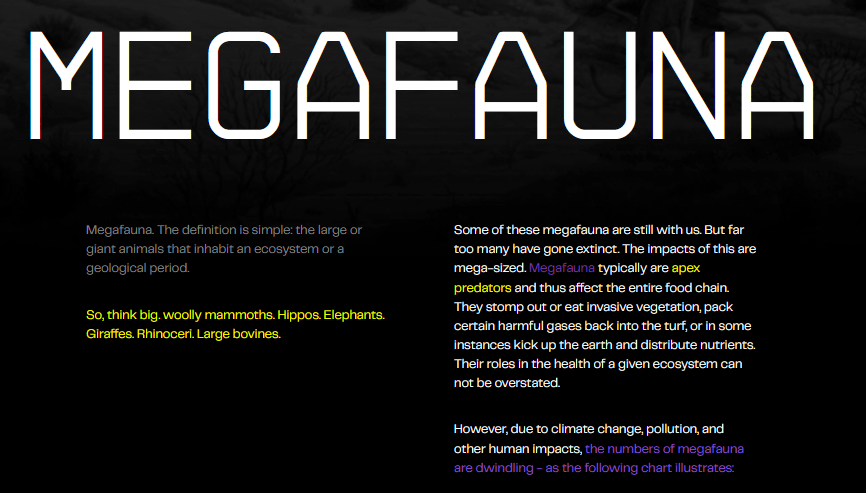
Ah yes, giraffes, the apex predators of the African Savannah. They hunt lions by ensnaring them with their giant necks, like snakes do, probably. Hippos meanwhile are well known to hide in shallow water ponds, waiting for animals to approach to drink and then strike. Or something like that.
Greenwashing
Colossal’s website is full of conservationist info. From “wolves are good for the environment and not really dangerous to humans” to various nature conservation success stories, it really feels like they’re part of something big. Except they’re not. Take their story of the Sumatran Rhino for example:
The only two-horned rhino left in existence. Isolated and dwindled down to a total of 80 in population. Locked into landscapes that make breeding in the wild next to impossible. The situation for the Sumatran rhino was dire. That is until the science world united with a disruptive plan to save the species. Years later, through relocation and focused efforts to promote breeding in safe environments, the Sumatran rhino has been given a strong, fighting chance and the outlook is increasingly positive.
Genetics enters the picture moving forward with de-extinction efforts aimed to accelerate the conservation of this megafauna by continually sequencing its genetic code in order to make a full reference genome for the species, thus preventing a total loss from ever taking place. This example is a true shining light in the efforts taking place today. And this didn’t happen in a silo. Governments, zoos, local entities, volunteers, worldwide federations and charities all played a hand.
See the disconnect here? The conservation effort taking place is happening without the genetics thing. Even their idea of a backup is strange: They’ve got the DNA, and then what? You can’t release DNA back into the wild, it just kinda flops onto the ground if you try. What you’d need is some sort of breeding and rewilding program, which notably isn’t what they’re involved in.
Beyond their “Dire wolf” and “wooly mouse”, experiments, the closest I can find to them actually helping real conservation is funding a vaccine for elephants.
Their “technology” page in contrast is refreshingly clear and straight-forward: They’ll use the knowledge they gather to genetically engineer livestock and agriculture products (ie, make GMOs), make vaccines, stem cell research, presumably grow human organs in more harvestable organisms than humans – normal biotech stuff.
And that’s the thing: Normal biotech stuff is just a lucrative business on its own and the founders know that as they’ve launched several dozen of the things. The de-extinction thing and its environmental impacts, impacts on climate and impacts on the ecology seem to be slapped on top of a viral marketing campaign, with no real plan to actually change the world for the better. They’re just doing what they’d be doing anyway, and once they found a way to make real money Monsato-style, they’ll probably hard-pivot that way.
De-extincting animals is likely unnecessary
Colossal wants to de-extinct 4 species: The wooly mammoth, the dire wolf, the dodo and the tasmanian tiger. This list appears to be carefully chosen based on popularity, rather than any particular need for the ecosystem.
A bigger wolf species is useful for taking down bigger prey. Bigger prey which notably is lacking in our current ecosystem. Normal wolves (grey wolves) are plenty capable of tackling virtually the entire breadth of prey available and, unfortunately for them, pretty much all of our livestock as well. As a result, every time Colossal talks about restoring balance between predator and prey, more often than not it’s just a question of allowing the predators to do their thing in the wild, while preventing them from breaking into livestock.
Indeed, it appears that their entire project falls apart at this question: Where are they gonna put these animals? People generally prefer artificially bred super-predators to not be released in their backyard or anywhere near it. Sure, you can initially release them in protected areas like national parks, but assuming they’re thriving in our environments, they’ll quickly go wherever prey is. So imagine any deer sightings to be wolf sightings.
As for the other animals… the tasmanian tiger was a marsupial which independently evolved into the carnivorous niche. As far as the ecosystem is concerned, any similar-sized cat or dog would fill the same niche as them. Its de-extinction would be culturally significant, but I doubt it’d be ecologically significant. Similarly, the dodo appears to have been outcompeted by pigs introduced by humans, so its reintroduction would similarly be not nearly as ecologically significant.
As for the mammoth, the idea appears to release it to the siberian permafrost to fix it and convert the existing (frozen) swampy environment into a steppe, which on the way would also trap methane by compacting the soil above it. Whether they’d actually be capable of doing that, and whether the “mammoths” would actually stay up there, as opposed to migrating south to the steppe (which would be a mammoth’s actual habitat) might be in the “worth a shot” category.
Or maybe it isn’t, and I’m just unable to find the relevant information on their website.
Suggestions to Colossal
As laid out here, I’m extremely skeptical of Colossal’s claims. But luckily, and I’m going to use second person here, there’s an easy way for you to convince me otherwise: Just publish your plan. Not in the form of a flashy website, but in the form of a plan which actually lists out what you want to achieve, and how to achieve it. Your chief scientist did write a book titled “how to clone a mammoth” a decade ago which from the summary appears to address some of the concerns I have laid out here. Is that the plan? If so, has a decade of research amounted to any change? If not, what is the plan?
A level headed publication on what you’re doing, what results you’ve found so far, what you’re trying to do and where uncertainties lie would be deeply appreciated. That way, others could review your plans, point out flaws early and make improvements, learn from it and apply learnings to their projects, perhaps already prepare areas for you to release your de-extincted animals into.
It would be this spirit of collaborative science, of multilateral preservation efforts which would make it much easier for me to accept that you’re actually serious to preserve nature – and not just yet another megalomaniac-led gigaproject intended to dazzle the public, suck up public funding and keep it in the pockets of billionaires who will finally make their own Jurassic Park on some private island.

 Leo Wattenberg
